
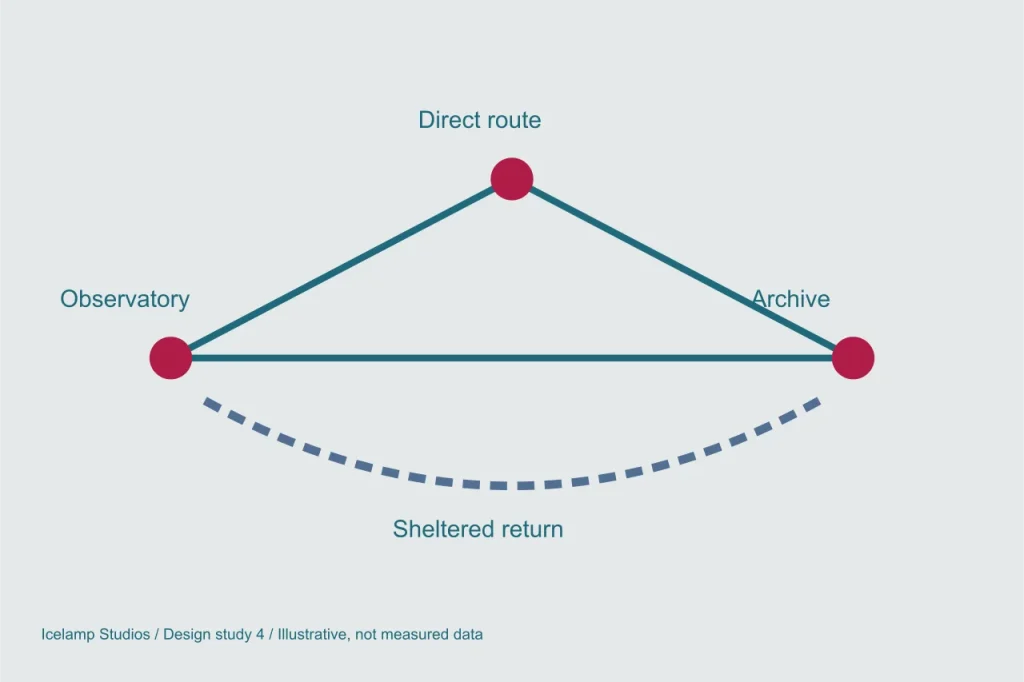
Arriving at a destination is only half of a route. In The Quiet Thaw concept, a useful plan includes the journey back, the passages that may change and the frost that remains after reaching the far side. This could become a compelling source of decisions, but it could also produce tedious accounting. The design problem is to make return costs visible and meaningful without forcing players to calculate every step before they are allowed to explore.
Begin with a recoverable mistake
Imagine a proposed scene with an observatory, an archive chamber and two connecting passages. The direct route is short but needs reinforcement during the warmer phase. The sheltered route is longer and remains usable with less work. A player who spends too much frost on the direct approach should still have a way home. The consequence might be a longer journey or a changed plan, rather than becoming trapped with no understandable recovery.
That recovery route is important for learning. If the first imperfect decision ends the session, the player sees a punishment but may not understand the system. A longer return lets the earlier choice remain visible. They can compare what they expected with what happened and choose differently next time. The scene must still respect their time: a detour should contain relevant observation or a new perspective, not simply repeat empty movement.
Separate travel cost from upkeep
Two kinds of expenditure are easy to confuse. Travel cost is the effort required to use a route now. Upkeep is the effort required to keep it available later. Combining both into one unexplained number would make planning difficult. The proposed ledger should describe them separately, using plain language and visible conditions. A passage can be easy to cross today while requiring attention before the next phase.
The difference creates choices with a time horizon. Maintaining a convenient connection may support several future trips. Leaving it alone may free frost for a destination that matters more immediately. Neither choice needs to be universally correct. The network becomes interesting when the player’s current purpose changes the value of a route. A fixed optimal maintenance order would turn an apparently open system into a repetitive checklist.
Make old observations visibly old
The ledger cannot offer live knowledge of every chamber, because then visiting and observing would add little. Yet uncertainty should be specific. An entry can show when a passage was last inspected and which condition was observed. A note from an earlier melt phase should look different from a fresh observation, without implying that it is automatically false. The player decides whether the remaining uncertainty is acceptable for the next trip.
On arrival, the landscape should resolve that uncertainty through clear evidence. Water may reach a marked band, an edge may have separated or a sheltered crossing may remain unchanged. If a route changes invisibly and the ledger simply announces a penalty, the world loses credibility. The visual study of layered ice is therefore part of this system design, not an unrelated art exercise.
Retiring a route can be progress
A network game can accidentally teach that every connection must be preserved forever. We want to leave room for a different conclusion. A passage that once served a useful purpose may no longer justify its upkeep. Recording its closure, choosing another approach and recognising its remains can all contribute to a sense of place. The history of a route includes decisions to stop maintaining it.
For a future prototype, the clearest evaluation would ask players why they kept one connection and let another go. If the answer is only “the interface told me to,” the priorities are not yet meaningful. If they can describe a destination, a risk and a recovery plan, the small network is beginning to work. Read The Quiet Thaw overview for the concept’s intended scope, or compare the immediate commitment in the bridge-anchor record. These are proposed design questions, not claims of a completed simulation.