
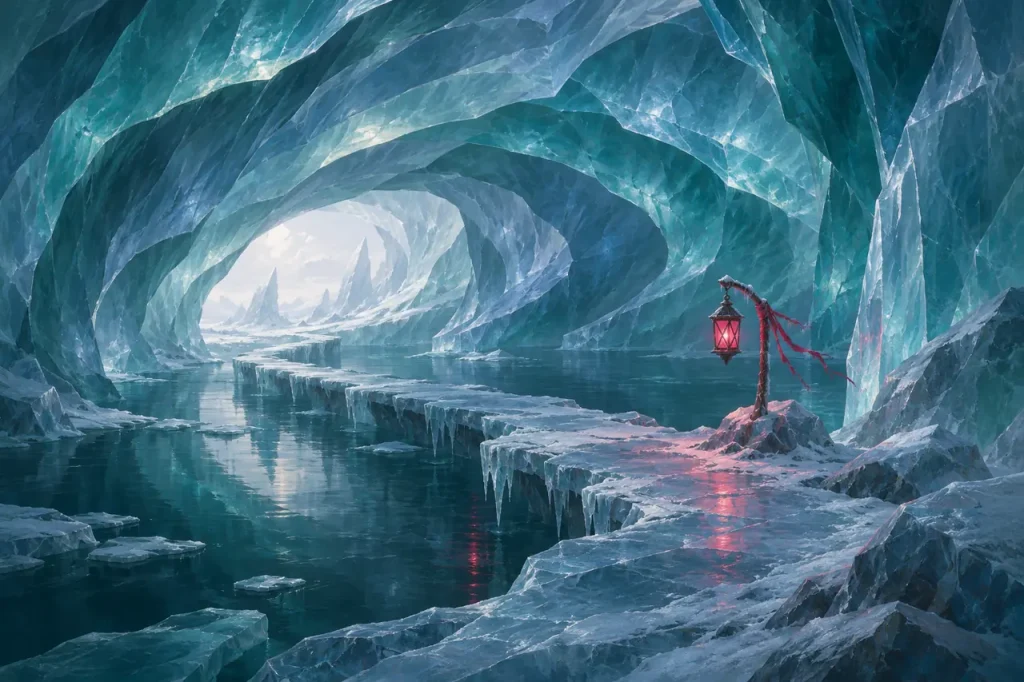
The Quiet Thaw considers what happens after a path has been made. This polar fantasy concept puts a small network of passages between the player and a handful of sheltered destinations. Ice changes over a recurring cycle, and the work is to keep useful connections available without treating the whole landscape as a machine that must remain perfect. A route can be retired, revisited or replaced as circumstances change.
A day begins with a route ledger
The proposed loop starts in an observatory with a short ledger of recent observations. Choose a destination and the passages that deserve attention on the way. Carry a limited amount of frost, inspect the first crossing and decide whether to reinforce it, use an alternative or mark it for a later visit. On returning, update the ledger with what you actually observed. The next plan begins from that record, including its uncertainty.
A ledger entry is not an omniscient sensor. It can say that water was shallow on the last visit, but a changing phase means the observation may now be old. That distinction allows preparation to matter without hiding information arbitrarily. The environment should provide current clues when the player arrives: reflected movement, a newly exposed band, or a widening seam beside a familiar landing.
Chambers with different needs
The fictional network links the Main Observatory, a shaded archive chamber and an open wind shelf. These destinations create different kinds of trips rather than a list of interchangeable errands. The archive favours a stable, sheltered passage. The wind shelf offers a broad view but can require a longer approach. The observatory is a place to compare observations and choose the next manageable task.
The landscape is intentionally small enough to learn. Familiarity is important: a change is meaningful when you remember how a place used to look. Repeated travel should reveal a history of decisions in the bridges, markers and abandoned approaches. We want a maintained path to feel like an ongoing relationship with the terrain, not a progress bar that resets between visits.
Melt as a design language
This project does not claim to simulate real glaciology. Its melt cycle is a fictional gameplay system with readable phases. Water level, access and route cost can change together, but their relationships must be explained through the scene. The development-log curve on this site illustrates that design structure and must not be mistaken for measured climate data.
The art direction moves below the surface: translucent blue walls, dark water, pale openings and occasional crimson route lights. Layered ice makes time visible. Reflections can point towards a passage, while a brighter edge marks recent frost work. These details should support a calm pace in which observation is an action, rather than merely scenery between objectives.
Maintenance without endless chores
The central design limit is that not every route needs saving. If upkeep becomes a requirement to repeat the same action everywhere, the concept loses its purpose. A useful maintenance decision offers a reason to prioritise one connection and accept the consequences elsewhere. The intended prototype therefore needs a small set of competing routes, not a vast checklist of damaged structures.
We would judge that prototype by whether a player can explain why a route was kept and what another choice would have enabled. The return-cost record explores this question, while Rift Lantern isolates the more immediate act of bridge construction. The Quiet Thaw remains a concept, with no announced release schedule or commercial availability.