
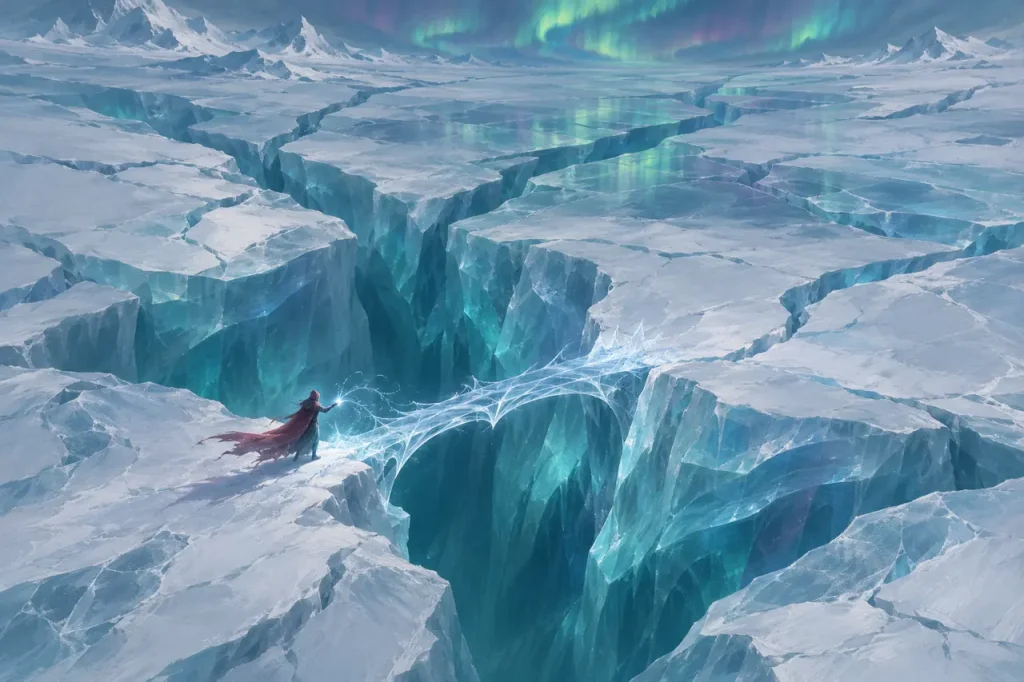
Rift Lantern is a game concept about making a route through a polar fracture field. You play a frost mage whose power can shape small spans of ice, but cannot flatten an entire landscape into a road. The proposed experience begins at a sheltered observatory and follows a chain of exposed ledges towards a distant signal. Reaching that signal matters, yet the return journey is part of every decision from the start.
Observe, shape, cross, remember
The core loop has four stages. First, inspect the gap and the surfaces around it. Next, choose an anchor on each side and preview a bridge shape. Then commit a portion of your frost reserve and cross the completed span. Finally, record the crossing as part of a route you may need again. The record is a compact memory aid: where the landing is sheltered, which edge is narrow and whether another approach is available.
We want the preview to explain consequences without solving the decision. It can show a proposed landing width and identify a visibly weak surface, but it should not replace observation with a single perfect-route marker. A broad span offers room to turn and inspect. A thin span conserves material. A raised curve can clear broken ice but exposes more of the crossing to wind. Those differences should remain understandable even in a small test scene.
The Lantern Reach
The fictional setting is the Lantern Reach, a glacier cut into shelves by branching rifts. Old route lights stand at a few sheltered locations, while the aurora remains a quiet presence above the field. There are no invented historical claims behind the setting. It is a fantasy landscape built around visible ice structures, reflected light and the practical difficulty of choosing a safe path through unfamiliar terrain.
Landmarks are deliberately uneven. A split pinnacle gives a long-distance bearing; a crimson lamp identifies a landing at close range; an exposed band in the wall confirms which shelf you have reached. These cues work at different scales so that navigation is not reduced to following identical lights. A player who looks back should recognise a crossing from its shape and surroundings.
Art and interaction direction
The colour scheme keeps deep teal and steel blue in the ice, pale grey on the surface and crimson in selected route markers. Newly shaped ice receives a crisp edge rather than an all-over glow. The aim is to preserve atmosphere while making the active structure readable. Movement should remain deliberate, with camera framing that shows both the departure ledge and the intended landing before commitment.
Accessibility is part of that communication problem. A weak anchor must have a pattern or shape cue in addition to colour. Important sounds need visible counterparts. The concept should offer time to inspect a route without requiring a quick reaction to understand basic information. Exact controls and accessibility options remain questions for the prototype rather than promised shipping features.
What the first prototype should answer
The proposed initial scope is a short outward route with an alternate return. Its purpose is to test whether two plausible bridges produce meaningfully different choices. We would examine whether the player can predict the consequence, notice it during crossing and describe the decision afterwards. A larger map would only be justified if that small sequence works.
Read the anchor design note for a closer look at support and commitment, or compare the slower maintenance approach in The Quiet Thaw. Rift Lantern is currently presented as a concept. No release date, platform availability or playable download has been announced.