
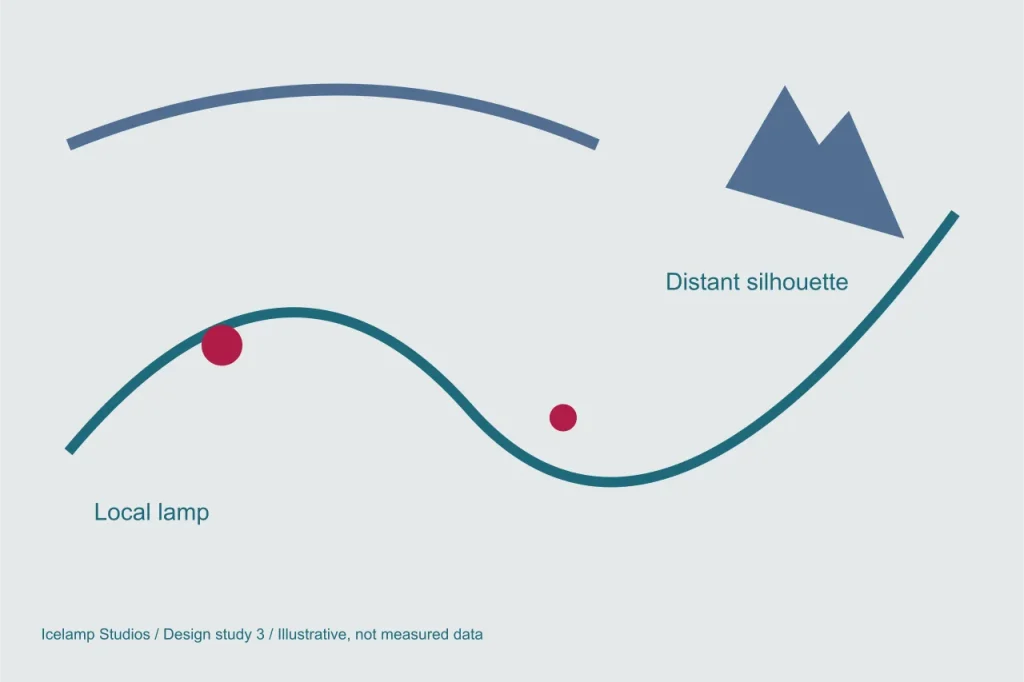
A row of bright lamps can make a route easy to follow, but it can also remove the act of finding a way. Rift Lantern needs navigation that supports observation without turning every journey into a sequence of identical beacons. The proposed solution gives different landmarks different responsibilities. A lamp identifies a nearby crossing. A silhouette provides a distant bearing. A band of light on ice can reveal the orientation of a wall without naming a destination.
Local certainty, distant interpretation
At close range, a route marker should be dependable. If a crimson lantern stands beside a usable landing, its position needs to be unambiguous and stable. The player should not have to guess whether it belongs to the shelf above or the passage below. A small pool of reflected light and a recognisable mounting shape can tie it to the ground. The marker confirms a place that the player has already approached.
Farther away, navigation can ask for interpretation. A split pinnacle may indicate the direction of the observatory without marking an exact path. The player still needs to read the intermediate terrain. This distinction preserves a useful rhythm: establish a general bearing, inspect a local crossing, then check the broader orientation again. A single floating objective icon would combine those stages and risk making the glacier a surface to move across rather than a place to learn.
The sleeping aurora
The aurora is part of the fictional world’s atmosphere, but it should not become an unreliable compass that quietly changes the rules. If its reflection helps identify a wall, the relationship must be visible and consistent within the scene. Broad light can establish which direction is open to the sky. It should not be the only evidence of a safe route or a hidden requirement for progressing.
Movement in the sky also competes with activity on the ground. A strongly animated aurora might attract attention just as a player needs to inspect an anchor. We would begin with a restrained treatment, then review whether the atmosphere supports or interrupts the decision. Accessibility options would need to address motion and contrast together. Turning down visual movement should not remove information essential to understanding a crossing.
Recognising a place from behind
A useful landmark is not merely visible from its preferred camera angle. Consider a lamp attached to a narrow ice fin. On the outward journey, the fin may frame the light neatly. Returning from the opposite direction could hide it completely. The proposed review pairs both approaches and asks which stable feature remains. Sometimes the answer is a second visible surface, a reflected patch of colour or a distinctive silhouette rather than another lamp.
This also affects how routes are recorded. A note such as “the third red light” is fragile if the player misses one marker or approaches from elsewhere. A note that mentions a sheltered shelf below a split wall carries more useful spatial information. Written observations should therefore refer to features that can be recognised from several viewpoints. They supplement memory instead of acting as an exact script for movement.
A route worth learning
For a first navigation prototype, we would use a short loop with one point where the outward and return views differ substantially. The player could describe the destination before setting out and identify the same landmark after the loop. Confusion would be useful evidence only if we can locate its cause. Was the silhouette too generic, the local marker poorly attached to the terrain, or the camera unable to show the relevant feature?
The glacier-depth study addresses the visual hierarchy behind those questions. Rift Lantern provides the broader context of making and remembering crossings. This note does not propose removing guidance. It proposes assigning guidance a clear role, so that a lantern can help someone recognise a path while leaving room to understand the landscape around it.